What a wedding DJ actually does during your ceremony
Most couples picture me starting work at cocktail hour. That makes sense. The reception is where the dance floor is, and that's what people imagine when they hear "DJ." But at almost every wedding I do, the first job happens before anyone has a drink in their hand: I run the sound for your ceremony.
It's the shortest part of the day, usually 20 to 30 minutes for a ceremony at your venue. It's also the part you'll replay for the rest of your life. Here's what it looks like from where I'm standing, start to finish.
Before anyone sits down
My ceremony setup is a separate system from the reception. That matters more than it sounds. When the ceremony and the reception share a property, one system means tearing it down and rebuilding it while your guests watch from cocktail hour. With two, the ceremony gear comes down quietly and the reception is already set and waiting.
Before the day, I walk the space. For a venue I already know well, I go through the layout with your coordinator instead. I'm looking for the things that decide whether the back row hears you: how long the aisle is, where the guests sit, indoors or out, and where I can stand to see your officiant and the doors at the same time.
Power is one thing I don't need. My ceremony system is wireless and can run on batteries, so a ceremony on a golf course or out in the rows of a vineyard doesn't need an outlet nearby. I'd much rather not run long extension cords across a lawn your guests are walking on, so if there's no power where you want to say your vows, that's fine.
Guests start arriving 20 to 30 minutes before the time on your invitation, not at it. So the music starts then too. Something soft that people can talk over, chosen with you during planning, so the first thing your guests hear isn't silence and the scrape of chairs.
The microphones
Every person who speaks needs a plan. That sounds obvious, but it's where most ceremonies go wrong.
Your officiant. I use a wireless handheld mic. It's simple, it's reliable, and your officiant can hold it, set it on a stand, or hand it to whoever needs it next. I talk it through with them before the day, so it's one less thing on your list.
Your vows. Your officiant holds the mic up for each of you, or passes it over. If you're reading long vows, or you're soft-spoken, I plan for that separately.
Lapel mics. If you'd rather nobody holds a mic at all, lapel mics are possible, for an extra fee. One lapel isn't enough, though. To cover both voices properly, you need two: one on your officiant and one on one of you.
Readers and musicians. Anyone who reads or plays gets their own plan, so nobody walks up to a mic stand set for someone a foot taller.
Outdoors adds wind. Wind across a microphone sounds like a train to the back row, so outdoor setups get wind protection, and I set levels for the conditions on the day, not the day before. Feedback is something I prevent, not something I fix in front of a full room of your guests.
The cues
This is the part people don't see, and it's the part I care about most. A ceremony has a handful of moments where the music has to change at exactly the right second.
The processional. Your wedding party walks in to one song. Then there's a pause, the doors, and your entrance gets its own. I watch the doors, not a clock. If your flower girl stops halfway down the aisle to wave at her grandmother, the music waits for her.
The quiet moment nobody plans for. After the vows, you sign the register. It takes a few minutes, and almost nobody thinks about it until they're standing in it: a room full of guests sitting in silence, watching people sign paper. I play music through it, and I bring it down at the right moment so your officiant can present you. We pick a couple of songs for the signing together. One is usually enough, but I always have a backup ready in case it runs long.
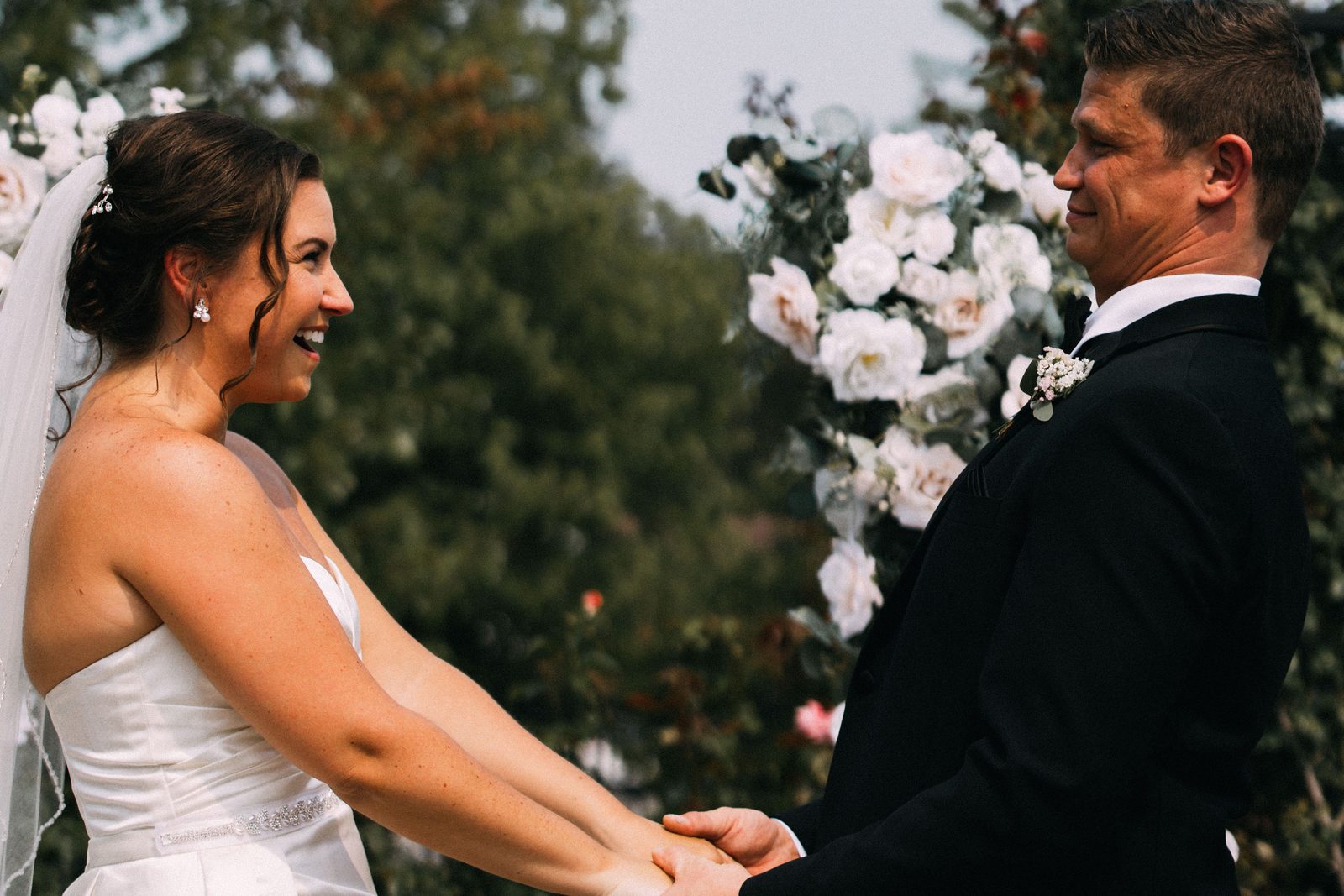
The recessional. The moment your officiant introduces you, the music hits. Not two seconds later while someone fumbles with a phone. That moment is in your photos and your video, and its energy carries everyone straight into cocktail hour.
Why a phone in someone's pocket isn't a plan
Plenty of ceremonies run from a phone plugged into a venue speaker, and sometimes that's fine. When it isn't, you get a text notification over the processional, a song that starts from the beginning instead of the right spot, or the cousin who was supposed to press play busy crying instead. Which, to be fair, is exactly what they should be doing.
Your ceremony is twenty minutes you can't redo. The person running the sound should have nothing else to do but watch, listen and press the right thing at the right moment. For those twenty minutes, that's my whole job.
It's included
I want to say this part plainly: ceremony sound is included in every package I offer. The Essentials, The Signature and The Full Experience all cover your ceremony, cocktail hour and reception, for one price.
I mention it because it isn't always the case. Ceremony coverage is often quoted as an add-on. So when you're comparing prices, check whether the number in front of you includes it. If it doesn't, add it before you compare.
If your ceremony is somewhere else entirely, like a church across town before a reception at your venue, tell me early. Two locations means two setups and travel between them. The cost depends on where the ceremony is and how far it is from your venue, so I'll quote it up front instead of surprising you later.
What I'll ask you during planning
So you can start thinking about it now:
Where is the ceremony, and is it indoors or out?
Who's speaking? Your officiant, readers, anyone singing or playing?
Is the handheld mic fine, or would you like lapel mics?
Which songs for the wedding party, your entrance, the signing and the recessional?
Is anyone walking in who might need the music to wait? Little ones, a grandparent, a dog.
Are there cultural or religious parts with their own music or timing?
Bring what you know. We'll fill in the rest together in your planning portal.
The short version
During your ceremony, I'm the person making sure every guest hears every word, and that each piece of music lands on the moment it belongs to. You won't notice me. That's the point.
If you have a date in mind, send it over. I'll tell you within 24 hours whether it's open and what it costs, ceremony included.